
Backflow Preventer Installation Near Me
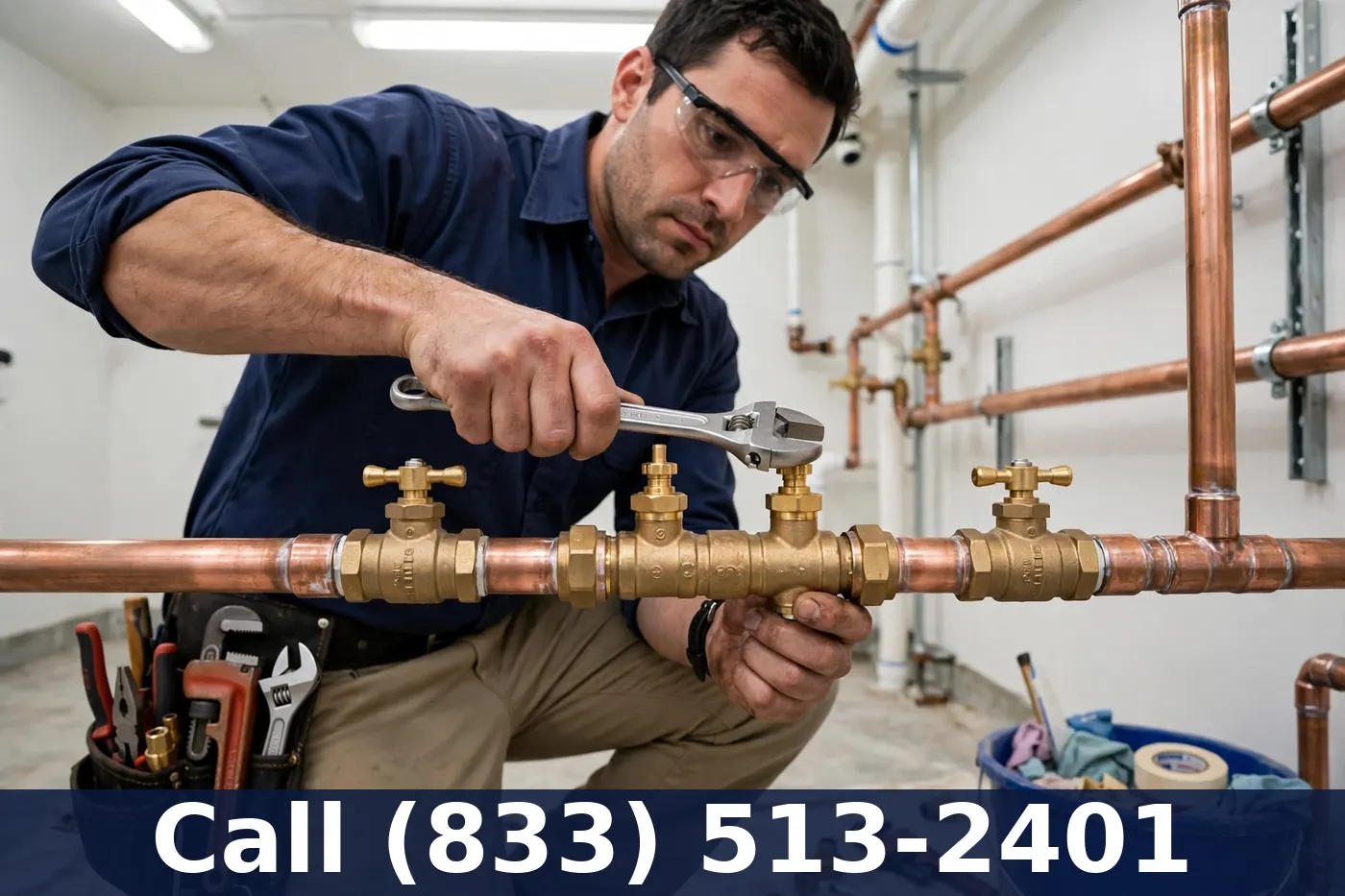
Starting price: Call for pricing
A backflow preventer is a one-way safety valve that stops water from flowing backward through your plumbing, keeping fertilizers, chemicals, and other contaminants out of your drinking water. Plumbing Services Pros installs pressure vacuum breakers, double check valve assemblies, and reduced pressure zone devices, sized and placed to meet your water utility's rules. It's the practical way to protect your water and stay on the right side of local code.
What a backflow preventer does — and what it doesn't
A backflow preventer is a mechanical device that lets water flow toward your fixtures and never backward. Inside, spring-loaded check valves stay open while water pressure pushes forward, then snap shut the moment flow tries to reverse. That one-way action is the whole point: it stops whatever is sitting in a downstream line from being drawn back into your clean supply.
What it doesn't do is clean or treat your water. It won't change your water pressure, improve taste, or remove minerals. It is strictly a safety barrier at the point where your plumbing meets something that could contaminate it — a sprinkler system, an irrigation line, a fire sprinkler, or a commercial process line. Think of it as a one-way gate, not a filter.
When your property needs one
- You have an irrigation or lawn sprinkler system tied into your drinking water
- A fire sprinkler line connects to your main supply
- You run a pool, fountain, or water feature with a fill line
- Your water utility sent a notice requiring a device or a test
- You're a business with a cross-connection, like a hose that sits in a mop sink
The most common trigger is a sprinkler system. Irrigation lines sit full of water, fertilizer, and lawn chemicals, so a pressure drop — a main break down the street, heavy hydrant use — can siphon that mixture back toward your house and the street main. Most water providers in this part of California require a device on irrigation lines for exactly that reason.
How we install it, start to finish
Every job starts with a look at the line. We find the water meter, trace the branch that feeds the irrigation or other connection, and check the pipe size and what's downstream. That tells us which device the situation calls for — a PVB, a DCVA, or an RPZ — and where it can legally sit.
Then we shut off the water and cut the device into the line, usually as close to the meter as the layout allows. PVB devices must sit at least a foot above the highest downstream outlet. A DCVA can sit lower and sometimes in a box below grade. An RPZ needs drainage below it because its relief valve can discharge water by design. We add shutoff valves and unions on both sides so the device can be tested and serviced later without cutting pipe.
Once the device is in, we pressurize the line and test it the same way an annual test is done — gauges on the test cocks, each check valve proven to hold, the relief valve confirmed to open on an RPZ. We record the readings and hand you the documentation your water provider asks for.
What affects the cost
The biggest cost driver is the device itself, and devices differ by type and pipe size. An RPZ runs higher than a PVB because there is more to it — two check valves plus a relief valve — and larger pipe sizes call for larger, pricier assemblies.
Access matters too. A device that ties into an exposed line near the meter goes in quickly; one that needs a box dug in, a vault below grade, or a longer pipe run adds labor. If the existing line needs rework — old corroded pipe, no room for shutoffs, a tight trench — that adds to the job. Permits, where the utility requires them, also factor in.
The surest way to know your number is to call (833) 513-2401 and describe the line the device would protect. We can usually give you a clear picture once we've seen the setup.
How we serve the area
Plumbing Services Pros installs backflow preventers for homes and businesses across the greater Stockton area — new sprinkler hookups, replacements for devices that failed testing, and first-time installs after a utility notice. We also handle the annual testing most water providers require, so the same team that puts your device in can keep its paperwork current year after year.
Call (833) 513-2401, tell us which line needs protection, and we'll take it from there: the right device, installed to code, tested on day one.
Features
- Walk-through of your water line, sprinkler, and irrigation connections to select the right device
- Pressure vacuum breaker (PVB) installation, set at the height the code requires
- Double check valve assembly (DCVA) installation for continuous-pressure lines
- Reduced pressure zone (RPZ) assembly installation for high-hazard connections
- New shutoff valves and unions on both sides so future testing is simple
- Device test on install day to prove each check valve holds
- Completed test paperwork for your water provider's records
Benefits
- Your drinking water stays safe from back-siphonage and backpressure events
- Sprinkler and irrigation systems keep running without endangering the water supply
- Compliance with water utility requirements for your property
- Fewer headaches at permit or property-sale time thanks to documented installation
- A device positioned for easy access at every annual test
- Confidence every time you turn on a hose or sprinkler zone
Frequently asked questions
What is a backflow preventer?
It's a device with spring-loaded check valves that lets water flow in only one direction. Installed on a water line, it keeps whatever is downstream — fertilizer in an irrigation line, chemicals, stagnant water — from being drawn backward into your drinking water when pressure changes.
Do I really need one?
If you have an irrigation or sprinkler system, a fire sprinkler line, or another cross-connection, your water provider almost certainly requires it. A Plumbing Services Pros plumber can confirm which device your line calls for and get it installed.
What's the difference between a PVB, a DCVA, and an RPZ?
All three stop reverse flow, but they're built for different risk levels. A pressure vacuum breaker suits irrigation lines and sits above the highest sprinkler. A double check valve assembly handles continuous-pressure connections. A reduced pressure zone device is for the highest-hazard connections and adds a relief valve that discharges if either check valve fails.
Will the device be tested after installation?
Yes. We test every device on install day with calibrated gauges, checking each check valve the way an annual test does, and we document the readings for your records and your water provider.
How much does a backflow preventer installation cost?
Cost depends on the device type, the pipe size, how accessible the line is, and whether permits or rework are needed. Call (833) 513-2401 for an exact quote — we'll look at your setup and tell you what the job takes.
Does my device need to be tested every year?
Most water providers require an annual test by a qualified tester, and some send reminder notices. Plumbing Services Pros performs that yearly testing too, so your device stays compliant after the install.