
Clay Pipe Replacement Near Me
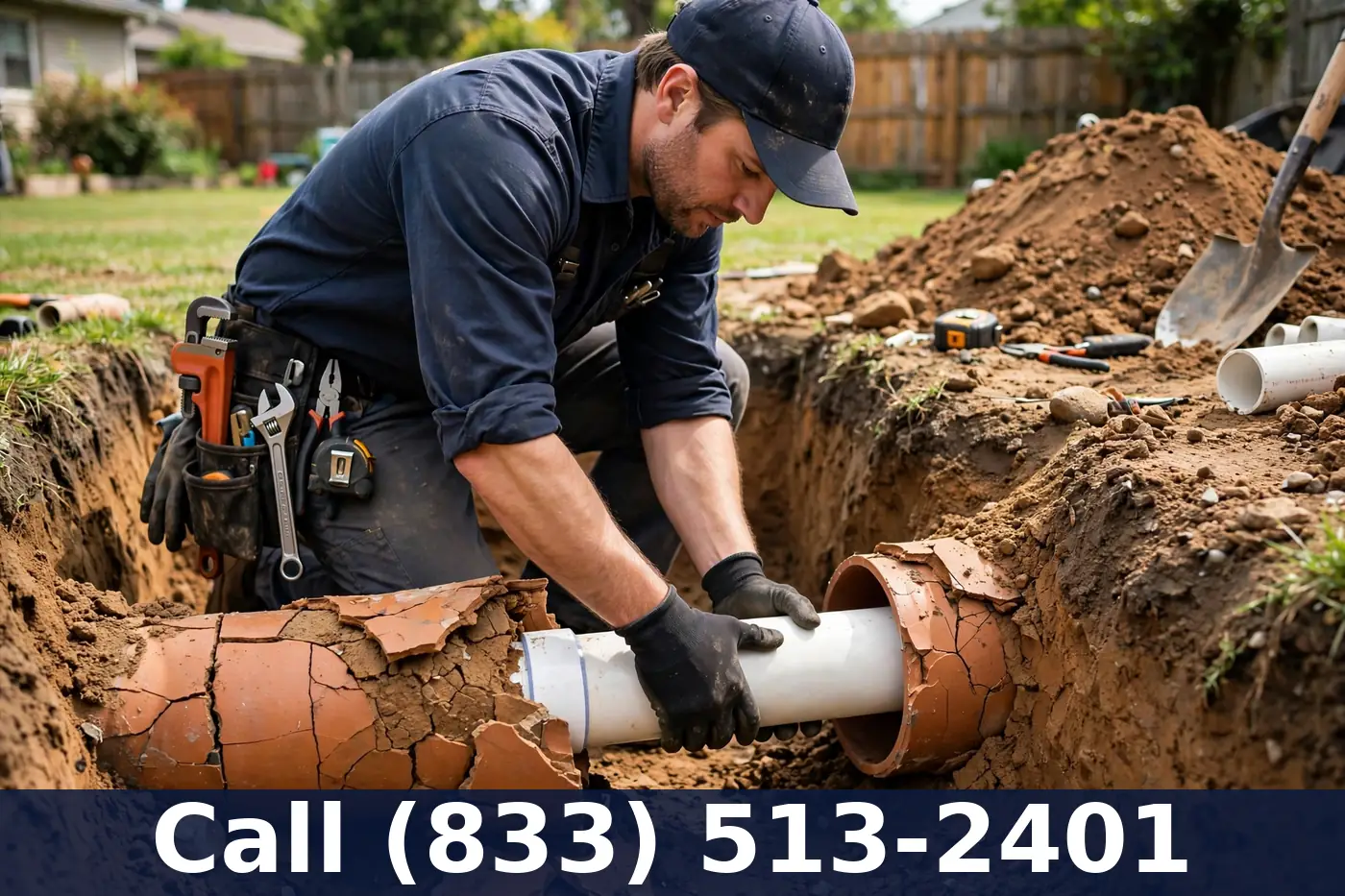
Starting price: Call for pricing
Many older homes around here still send their wastewater out through vitrified clay tile, a pipe joined in short sections every few feet. Those joints separate with age and invite tree roots in, and once roots are inside, backups become a regular event. Plumbing Services Pros replaces failed clay sewer lines with modern seamless pipe, so the problem actually ends instead of returning.
The clay pipe hiding under your yard
Before plastic pipe became standard, sewer laterals were built from vitrified clay tile: short fired-clay sections joined together every few feet, running from the house out to the street. In neighborhoods built in the middle of the last century, those clay lines are still in the ground, quietly aging. They weren't a bad product for their time, but time is the whole story here.
Clay doesn't rust, but it is brittle, and the joints between sections are its weak point. Soil shifts, ground settles, and those short sections drift apart by fractions of an inch. That's all a tree root needs. Once a root tip finds a seam, it pushes in, drinks, and grows, and the pipe becomes a regular source of backups that cleaning only clears for a while.
How a clay line actually fails
Clay pipe failure rarely happens all at once. It builds in stages that homeowners usually recognize once someone names them. First the joints separate just enough for fine roots to enter. Then the roots thicken into a mass that catches paper and waste, and drains start running slow. Hydro-jetting or snaking clears the mass, and everything works fine for a few months, until the roots grow back through the same open joints.
Meanwhile the pipe itself keeps aging. Sections can crack from ground movement, develop a sag (called a belly) that traps solids, or offset at the joints so waste snags on the lip. At that stage, no amount of cleaning fixes the geometry. The line is worn out, and replacement is the honest answer.
- Recurring backups that return months after each cleaning.
- Several drains backing up at once, or the lowest drain gurgling.
- Sewage smells in the yard or unusually lush patches of grass over the line.
- A camera inspection showing cracked sections, offsets, or heavy roots.
What replacing the line involves
Every replacement starts with a camera inspection. The camera travels the full length of the lateral, recording material, joint condition, depth, slope, and every defect. That footage is the basis for everything: the method, the route, and whether a full replacement or a targeted repair is the right call.
Where the line qualifies, pipe bursting replaces it trenchlessly. A bursting head pulls a new seamless HDPE pipe through the path of the old clay line, fracturing the old pipe outward and clearing out root masses as it goes. The work happens through small access pits at each end, so the lawn, driveway, and landscaping above stay largely intact. Where the line is fully collapsed, sharply misaligned, or has bad grade, traditional open excavation is the better method, and we'll say so plainly.
Either way, the old jointed clay comes out and a modern seamless pipe goes in. Connections are re-established at the house and the street, cleanouts are brought up to current practice, and a final camera pass confirms the new line flows clean with proper slope.
What shapes the cost of clay pipe replacement
Sewer work is priced on the facts of the line, so call (833) 513-2401 for an assessment rather than guessing. Length is the obvious factor: a longer run needs more pipe, more labor, and more restoration. Depth matters because deeper pipe means more digging. Access matters too — a line under open lawn is simpler than one under a driveway or a mature tree.
The method plays a part as well. Trenchless work uses specialized equipment, while open excavation means more digging and more surface restoration afterward. Soil conditions, utility lines crossing the route, and any permits the job needs all factor in. A camera inspection first means the price you discuss is based on your actual line, not a guess.
Replacing clay lines around Stockton
Plumbing Services Pros replaces clay sewer lines for homes across the Stockton area, where mid-century neighborhoods still run plenty of original tile laterals. The combination of mature trees, shifting soils, and aging joints makes this one of the most common underground problems we see. Many of these homes have lived through years of repeat cleanings before the line finally gets replaced.
If your drains keep backing up and the house is old enough to still run clay, start with a camera inspection. Call (833) 513-2401 and tell us what's been happening with your drains — we'll explain what the footage shows and whether replacement, a targeted repair, or just honest monitoring is the right move for your line.
Features
- Camera inspection of the full sewer line
- Mapping the line's route, depth, and condition
- Trenchless pipe bursting where the line qualifies
- Traditional excavation when the line needs it
- New seamless, root-resistant replacement pipe
- Final camera pass to confirm flow and grade
Benefits
- An end to the cycle of root-caused backups
- A smooth, joint-free line that roots struggle to enter
- Drains that move waste the way they should
- Fewer emergency calls for the same sewer problem
- A modern pipe built to serve the home for decades
- Clear knowledge of exactly what's buried in your yard
Frequently asked questions
How do I know if my sewer line is clay?
If your home was built decades ago and you've never had the sewer line replaced, a camera inspection is the way to find out. The footage shows the pipe material, joint condition, and any root intrusion clearly. Call (833) 513-2401 and we can set up that inspection and explain what we see.
Will roots still be a problem after the clay is replaced?
Roots enter through the joints between clay sections, so a new seamless pipe takes away their entry points. That doesn't stop roots from growing near the line, but it stops them from getting inside it. The pipe itself resists penetration, which is what breaks the cycle.
Do you dig up the whole yard or use trenchless methods?
It depends on the line's condition and what's above it. Trenchless pipe bursting replaces the line through small access pits, which suits yards with landscaping, driveways, or patios overhead. A severely collapsed or sharply misaligned line may need open excavation. The camera inspection tells us which method your line actually qualifies for.
How much does clay pipe replacement cost?
Length, depth, access, and soil conditions all shape the job, plus which method the line qualifies for. A short, shallow run in open soil is one kind of project; a deep line under a driveway is another. Call (833) 513-2401 for an assessment of your line and a clear explanation of what the work involves.
Can you repair part of a clay line instead of replacing it all?
Sometimes. A single separated joint in an otherwise sound line can get a targeted repair. But when clay shows cracking at multiple joints, heavy root intrusion, or sagging sections, replacing the run is the fix that lasts. The camera footage makes the call obvious one way or the other.