
Gas Line Pressure Testing Near Me
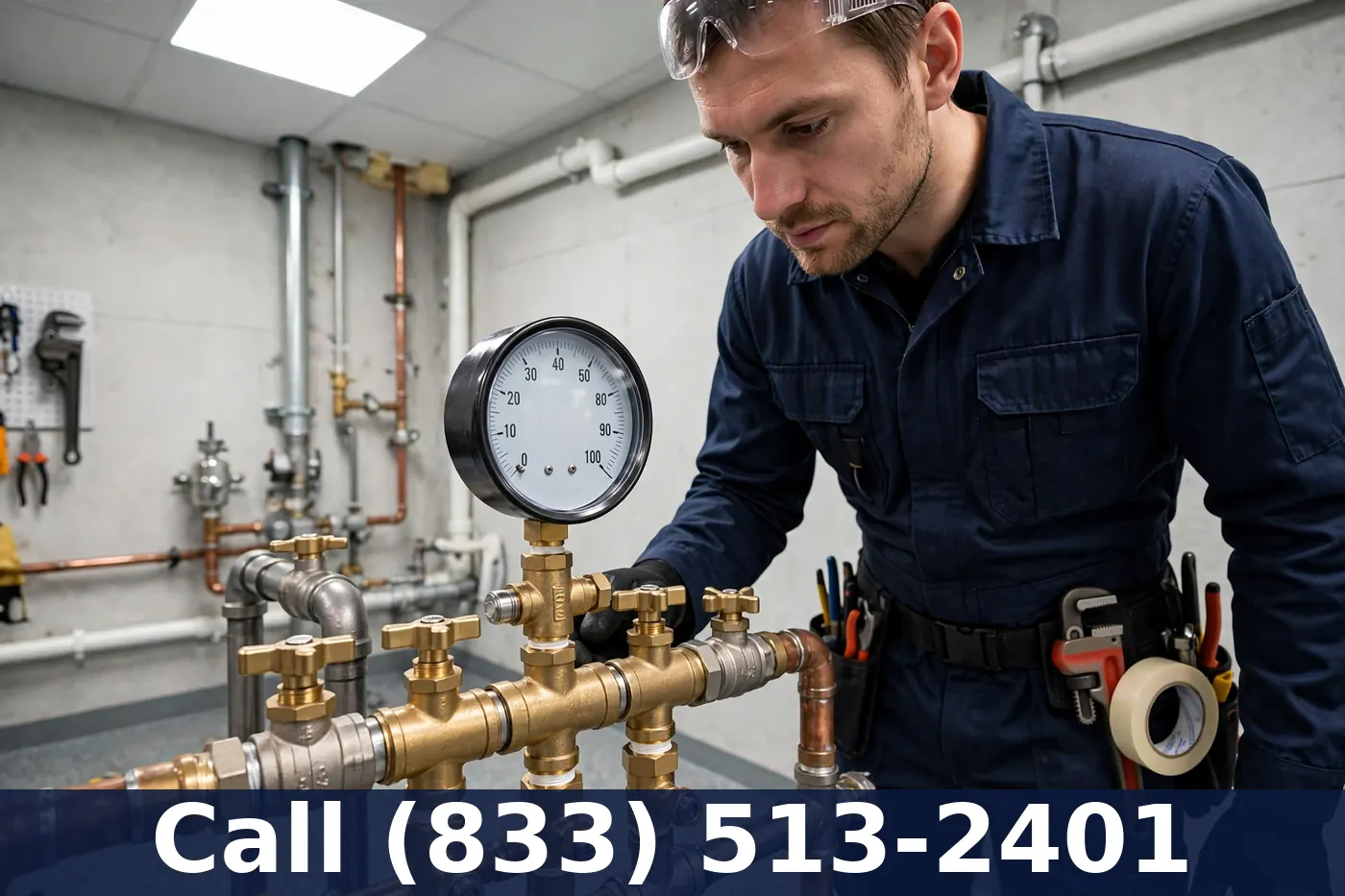
Starting price: Call for pricing
Gas line pressure testing from Plumbing Services Pros verifies that your gas piping is leak-tight before it goes into service — or confirms a suspected leak in an existing line. We isolate the piping, pressurize it with air, and watch a calibrated gauge over a hold period. A steady reading passes; any drop tells us exactly which section needs attention.
What a Pressure Test Proves
A gas line pressure test answers one question with unusual finality: does this piping hold, or does it leak? Plumbing Services Pros caps off the section of piping under test, charges it with air to a set pressure, and watches a calibrated gauge over a hold period. If the needle sits still, the section is tight. If it drifts down, gas is escaping somewhere in that section — no debate, no guessing.
This is the test that stands behind new gas installations and repairs. It is also the tool of last resort for the phantom gas smell — the faint, occasional odor that detectors and soap bubbles cannot quite pin down. Where visual inspection says the piping looks fine and the nose says something is off, the gauge settles it.
When a Test Is the Right Move
New gas piping gets tested before it is covered or buried — that is standard practice and usually part of the permit inspection. Repaired sections get tested after the fix, to prove the repair holds before the wall closes back up. Beyond those, pressure testing earns its keep in a few specific situations:
- A gas odor that comes and goes but never gets found by other methods
- A remodel that exposes old, questionable piping before new finishes go in
- A home purchase where the buyer wants the gas system verified
- An inspector or gas utility requiring a documented test result
- Appliances that underperform in ways that suggest a supply problem
If the situation is an active, strong gas smell, skip straight to the safety steps — leave the house and call the gas utility's emergency line. Pressure testing is for the cases where the immediate danger is past and certainty is what you need.
How the Test Runs
First the setup. We locate the section of piping to test, shut off the gas supply, and cap or isolate the section from the rest of the system and from every appliance. A calibrated gauge goes on the test port, and the section is charged with air to the test pressure called for by the situation.
Then the hold. The gauge is watched over a set period — commonly around fifteen minutes for diagnostic tests, longer where code or the inspector requires it. A leak-tight section shows a rock-steady reading the whole time. Even a small, measurable drop is a fail, and it means the search narrows: the section gets divided, each part is tested on its own, and the failing segment gets divided again until the leak is cornered.
What you receive is a result you can act on. Pass means the piping is sound and the system can be put into service. Fail means we know which section is losing pressure, which becomes the starting point for finding the exact joint or damaged spot — and for planning the repair.
After a Failed Test: What Comes Next
A failed test is information, not a catastrophe — it is the test doing its job. The next step is localization: dividing the failed section and retesting until the leak is isolated to a manageable stretch of pipe. Then the specific source gets found with soap-bubble testing or a detector sweep, and the repair is planned around what is actually wrong — a loose fitting gets tightened and re-sealed, a damaged section gets cut out and replaced.
The repair itself is then tested the same way before anything is closed up or buried. That re-test is what closes the loop: the section that failed now holds, and the documentation reflects it. We explain each step as it happens, so you always know where the process stands and what the finding means.
What Affects the Cost
The amount of piping under test is the main factor. A single short run — one appliance branch, one repaired section — is a compact job. A whole-house system means isolating, charging, and watching multiple sections in sequence, and the time adds up with each one.
Accessibility matters as well. Exposed piping in a garage, basement, or crawl space is quick to reach and cap; buried exterior lines and piping behind finished walls take more setup because each test point has to be accessed. If the test fails and the leak must be traced section by section, the localization work becomes part of the visit — which is exactly what you want, since finding it is the point.
Documentation adds value rather than cost: a written pass/fail result is what inspectors and utilities ask for, and it is part of what we provide. For a scoped answer on your situation, call (833) 513-2401 and tell us what prompted the test — new install, a repair, a smell that won't resolve, or an inspection requirement.
Features
- Isolation of the piping section to be tested
- Calibrated pressure gauge fitted to the test port
- Air charge to the specified test pressure
- Monitored hold period watching for any pressure drop
- Section-by-section retesting to isolate a failing segment
- Written test result showing pass or fail and what it means
Benefits
- Proof your piping holds pressure before gas flows through it
- Hidden leaks caught while walls are still open or pipe is exposed
- A documented test result for permits and inspections
- Confidence that new or repaired lines are sound
- Small problems found before they become gas odors in the house
Frequently asked questions
What's the difference between pressure testing and gas leak detection?
Detection finds where gas is escaping; pressure testing proves whether a section of piping leaks at all. The two often go together — a pressure test confirms a leak exists, and detection methods then pinpoint the exact joint. Think of the pressure test as the verdict and detection as the investigation.
Does pressure testing require the gas to be on?
Yes. For the test, the gas supply is shut off and the piping is charged with air instead. That keeps the test safe and lets us use a precise gauge reading rather than relying on smell.
When is a pressure test needed?
After new gas piping is installed, after a repair, when a faint gas smell can't be traced by other means, during a remodel that exposes old piping, or when an inspector or gas utility requires a documented test.
How long does a pressure test take?
It depends on the size of the system and how many sections need testing. A single short run is relatively quick; a whole-house test with multiple isolated sections takes longer because each section is pressurized and watched in turn.
What happens if my gas line fails the pressure test?
Then we narrow it down. The piping is divided into smaller sections and each is tested separately until the failing section is identified. From there we find the specific joint or damaged spot and plan the repair — the test result becomes the map for the fix.
What does a gas line pressure test cost?
The scope of the system drives it: how much piping must be isolated and tested, how many sections that requires, and how accessible the piping is. A short exposed run is simpler than buried piping or lines behind finished walls. Call (833) 513-2401 and describe the situation for a scoped answer.