
Heat Pump Water Heater Installation Near Me
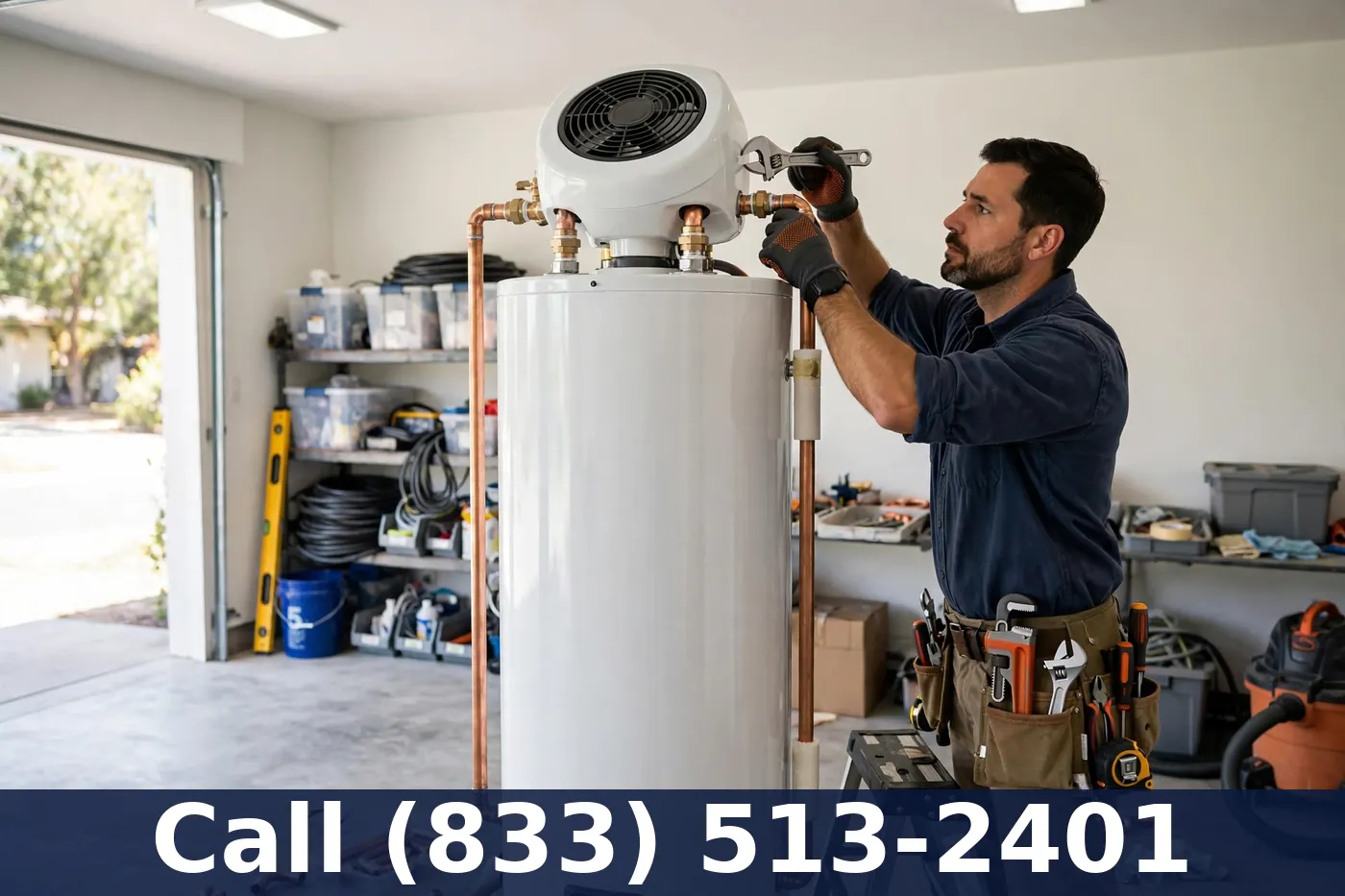
Starting price: Call for pricing
Heat pump water heater installation from Plumbing Services Pros puts an efficient hybrid unit in your home — one that pulls warmth from the surrounding air to heat your water instead of relying on resistance elements alone. We assess your space for air volume, temperature, and drainage, then handle the plumbing, electrical, and condensate setup. You get a high-efficiency system installed the way the manufacturer intended.
A Different Way to Heat Water
A heat pump water heater does not heat water the way a standard electric tank does. Instead of pushing electricity through resistance elements to create heat, it runs a refrigeration cycle in reverse: a fan draws in surrounding air, the heat pump extracts warmth from that air, and the heat moves into the tank. Electric resistance elements are still there as backup for heavy demand, but they do the minority of the work. The result is a unit that delivers the same hot water while drawing substantially less electricity.
That efficiency comes with a trade the installation has to respect. The unit's performance depends on its environment — the temperature and volume of the air around it, and a place for the moisture it pulls from that air to drain. Plumbing Services Pros treats the site assessment as part of the installation, not an afterthought, because a heat pump water heater in the wrong space loses the advantage you bought it for.
Who Gets the Most From One
Households with steady, significant hot water use see the biggest payoff — families with daily showers, laundry, and dishes running, where a standard electric tank works hard all day. If your current electric water heater is a major part of your electric bill, the contrast after switching is usually noticeable.
The space matters as much as the usage. Homes with a garage, a large utility room, or a basement that stays in a moderate temperature range year-round are natural fits. The unit also dehumidifies as it runs, which is a genuine bonus in damp garages and laundry areas — less moisture in the air, fewer musty corners. Households sensitive to noise should plan the location with care, since the fan and compressor produce a steady low hum during operation.
The Site Requirements That Decide Everything
Air volume comes first. The heat pump continuously draws heat out of the surrounding air, so it needs a generous volume to work with — manufacturers typically call for several hundred cubic feet of open space. A cramped closet starves it; the unit recirculates its own cooled exhaust, efficiency collapses, and the compressor cycles excessively. Where the room is too small, options include ducting air to and from the unit or improving ventilation with a louvered door.
Temperature is the second gate. Heat pump water heaters perform best in a moderate ambient range, and below that range the system leans harder on its backup resistance elements — which erodes the efficiency advantage. In mild-climate homes, a garage or utility room usually stays comfortably in range. We check your actual conditions rather than assuming.
Drainage is third. Dehumidifying the air produces condensate, and the unit needs a drain line routed to an approved discharge point — a floor drain, a laundry standpipe, or a condensate pump where gravity will not cooperate. And the electrical side: the unit needs a dedicated circuit with adequate capacity, which we verify at your panel during the assessment.
How the Installation Unfolds
It begins with the assessment: we measure the space, check air volume and clearances, confirm the ambient temperature profile, map the condensate route, and inspect your electrical panel for the circuit the unit needs. Tank sizing follows your household — bathrooms, occupants, and the heaviest hot-water hour of your day — because an undersized tank forces the backup elements on and an oversized one wastes the efficiency you are paying for.
Installation day starts with the old unit coming out. The new heat pump water heater is set level with proper clearances for airflow and future service access. Plumbing connections go in with new shutoff and supply valves; the electrical circuit is connected; the condensate line is routed and secured. Every connection follows the manufacturer's specifications, because these units are particular about airflow, drainage, and electrical supply.
Commissioning is the final phase and it matters more here than with a standard tank. We set the operating mode — heat-pump-first for maximum efficiency, with the backup elements available for high-demand stretches — then test a full heating cycle, verify the condensate drains properly, and confirm the controls behave as expected. You get a walkthrough of the modes, the filter maintenance the unit needs, and what normal operation sounds like.
What Affects the Cost
The unit you choose sets the baseline — capacity, efficiency tier, and feature set vary across the lineup. Site conditions are the next major factor: a garage with open space, a nearby drain, and an available circuit is the straightforward scenario, while a tight room needing ducted airflow, a long condensate run, or electrical work to make a circuit available adds scope.
Supporting work rounds it out. Removing and hauling the old tank, upgrading supply valves, adding a condensate pump where gravity drainage is not possible, or modifying the space for proper clearances all fold into the project. What you are really buying is the efficiency working as designed — and that depends on the installation being done right.
The assessment is where all of this gets answered for your home specifically. Call (833) 513-2401 and we will look at your space, your panel, and your hot water needs, then lay out exactly what the installation involves.
Features
- In-home site assessment for air volume, temperature, and drainage
- Tank sizing matched to your household's hot water demand
- Plumbing connections with new shutoff and supply valves
- Dedicated electrical circuit check and connection
- Condensate drain line routed to an approved discharge point
- Full commissioning: modes set, operation tested, controls explained
Benefits
- Water heated by moving heat, not just making it — far less electricity
- A garage or utility room that stays drier thanks to dehumidifying
- Quieter, cleaner operation than an aging electric tank
- A modern unit sized to your household's real hot water use
- Professional setup that protects the efficiency you paid for
Frequently asked questions
How does a heat pump water heater actually work?
Instead of creating heat directly, the unit transfers warmth from the surrounding air into the tank using a refrigeration cycle — like a refrigerator running in reverse. Resistance elements step in only when demand is unusually high. Because it moves heat rather than creating all of it, it uses far less electricity than a standard electric tank.
Where in my home can a heat pump water heater go?
Garages, large utility rooms, and basements with enough open air volume work best. The unit needs a steady supply of ambient air in a reasonable temperature range, plus a place to drain the condensate it produces. Small sealed closets are usually a poor fit — we assess your space during the visit.
Are heat pump water heaters noisy?
They make a low hum from the fan and compressor — roughly comparable to a running dishwasher or a quality refrigerator. We recommend placing the unit away from bedrooms and living spaces where possible, and we will talk through noise expectations for your layout.
Do heat pump water heaters work in cold weather?
Below a certain ambient temperature, the heat pump becomes less effective and the unit leans on its backup resistance elements. In a mild-climate garage or utility room, that is rarely an issue. Placement and your local conditions decide how often the backup engages.
Will my electrical panel need an upgrade?
Possibly. Heat pump units need a dedicated electrical circuit with adequate capacity, and some older panels need attention before the install. We check your panel and the available circuit during the assessment and tell you what, if anything, must change.
What affects the cost of installing one?
The unit itself, the site conditions, and any supporting work. A straightforward swap in a suitable garage is one scope; a tight space needing ducting for airflow, a new condensate drain route, or electrical work adds to it. Call (833) 513-2401 for an assessment of your home and a scoped quote.