
Pipe Bursting Near Me
Starting price: Call for pricing
Pipe bursting is a trenchless way to replace a failed underground pipe: a bursting head is pulled through the old line, fracturing it outward into the soil while a new HDPE pipe follows right behind into the same path. It needs only small entry and exit pits instead of an open trench. This service is for homeowners whose sewer or water line has collapsed, cracked apart, or been ruined by roots — and who want a full replacement without digging up the property.
What pipe bursting is and is not
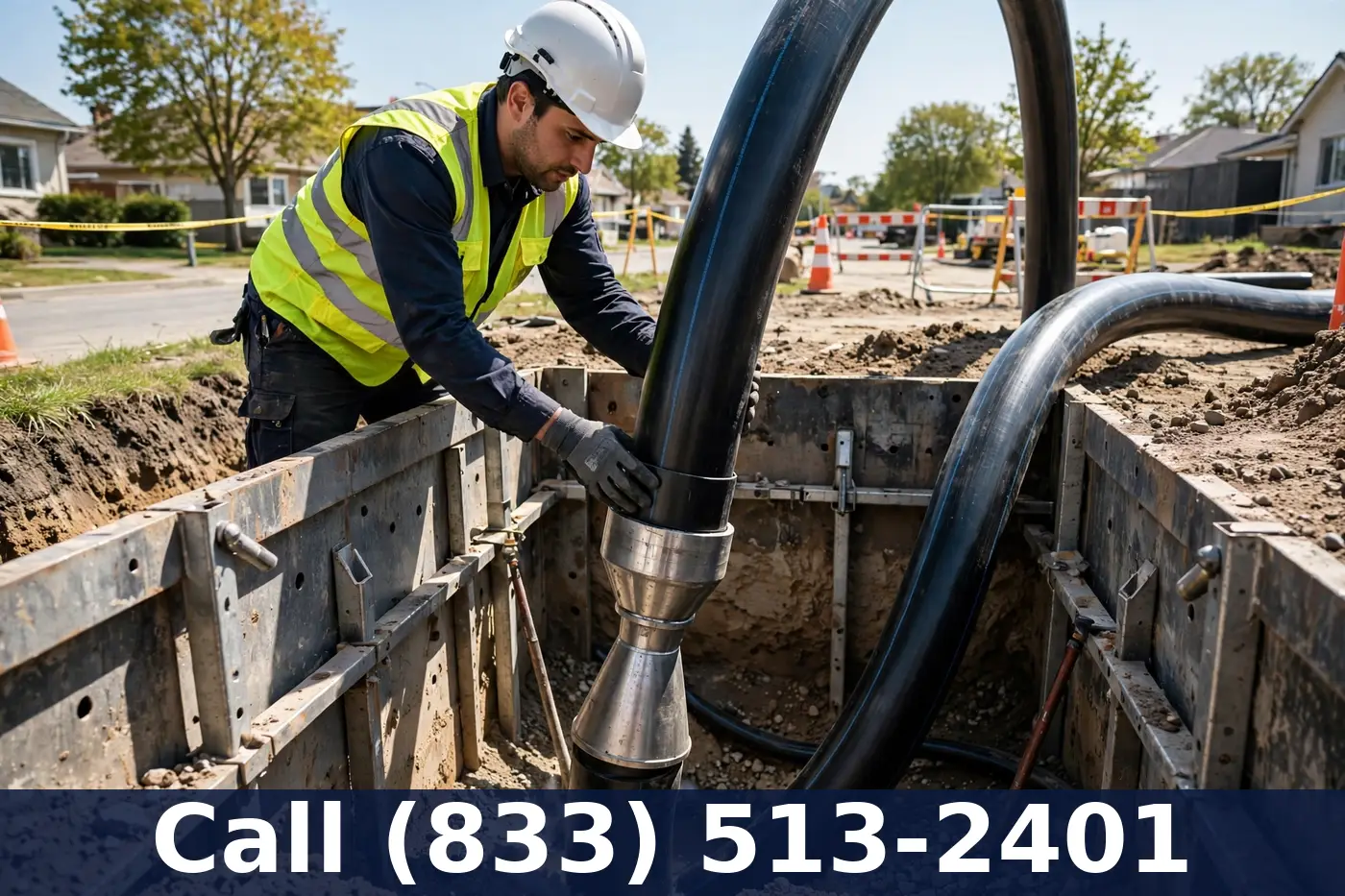
Pipe bursting is a trenchless replacement method for underground pipes that have failed. Instead of digging a trench the full length of the line, we dig two small pits — one where the pipe leaves the house, one near the street connection — and pull a cone-shaped bursting head through the old pipe on a steel cable. As the head advances, it breaks the old pipe outward into the surrounding soil. Right behind the head comes the new pipe, sliding into the exact path the old one occupied.
What comes out of the ground is a completely new line, not a repaired one. That distinction matters. Patching, lining, and spot repairs all work with the old pipe; bursting removes it from the equation. It is not the right method for every line — a pipe with a bad sag in its slope, or one running tight against a gas or water service, may still need open excavation. The camera inspection decides that before anyone digs.
The pipe problems that call for bursting
- A sewer line that has collapsed or caved in
- Clay tile or cast iron eaten through by corrosion and roots
- Orangeburg pipe that is softening and deforming underground
- An undersized line that cannot keep up with the household
- Repeated backups that keep returning after cleanings
- A line with long cracked sections that lining cannot bridge
How the job runs, start to finish
Everything begins with the camera. We run it through the line to find the damage, measure depth and length, and check the soil and surroundings. If bursting fits, we mark the two pit locations and get any needed permits.
On work day the crew digs the entry and exit pits and threads a steel cable through the old pipe. The bursting head goes on the front, the new HDPE pipe attaches behind it, and a hydraulic puller draws the whole assembly through. The old pipe fractures outward into the soil as the new line takes its place. Sections of HDPE are heat-fused above ground into one continuous length before the pull, so there are no joints in the run at all.
After the pull we camera the new line to confirm it is clean and properly seated, connect it at both ends, backfill the pits, and restore the surface. You are left with two patched work areas instead of a scar across the yard.
Bursting versus lining versus open-cut digging
Three methods, three different situations. Lining creates a new inner wall inside a pipe that still has its shape — best for cracks and corrosion that have not caved the pipe in. Bursting replaces a pipe that is beyond saving, with almost no surface damage. Open-cut digging exposes everything, which is necessary when the pipe's slope must be corrected or the layout itself has to change.
Cost comparisons have to include restoration. An open-cut quote can look similar until you add new concrete, repaved driveway sections, and regraded landscaping. Bursting skips nearly all of that, which is why the all-in number often lands lower even when the trenchless work itself is the bigger line item.
What affects the cost of a bursting job
Length and depth are the big ones — a short shallow lateral and a long deep one are different projects. Diameter matters because larger pipe and bigger heads take more equipment. Soil conditions play a role: rocky or tightly packed ground is harder on the pull than soft loam. Access counts too — tight side yards and lines running under additions or pools complicate the pit work.
Then there is the question of what the line connects to and whether the city tap needs attention. We price the whole picture after the inspection, and we walk you through what is driving the number when you call (833) 513-2401.
Homes and properties this suits in the area
Plumbing Services Pros performs pipe bursting for single-family homes across the Stockton area, where older clay and cast iron laterals are reaching the end of their useful life. It is also a strong fit for properties with expensive surfaces over the line — new driveways, patios, mature landscaping, or additions that would be ruinous to trench through.
If your sewer keeps backing up and cleanings only buy a few months, call (833) 513-2401. A camera inspection will show whether your line is a bursting candidate or whether a simpler fix will do.
Features
- Camera inspection to map the line and confirm bursting is the right method
- Small entry and exit pits instead of a full-length trench
- Hydraulic bursting head that fractures the old pipe outward
- New continuous HDPE pipe pulled in behind the head
- Heat-fused joints for a seamless, root-resistant line
- Option to upsize the pipe diameter in the same run
- Backfill and cleanup of the work pits when the pull is done
Benefits
- A brand-new pipe instead of a patch on a failing line
- No long trench tearing up the yard, driveway, or patio
- Most residential jobs finish without days of disruption
- The new line can be the same size or upsized for better flow
- Seamless pipe with no joints for roots to work into
- Landscaping, concrete, and hardscaping stay intact
- A full replacement that solves the problem at its source
Frequently asked questions
How is pipe bursting different from pipe lining?
Bursting is for pipes too far gone to save — collapsed, badly cracked, or made from materials like Orangeburg that are falling apart. Lining coats the inside of a pipe that still holds its shape. A camera inspection by Plumbing Services Pros shows which one your line qualifies for.
Can pipe bursting install a bigger pipe than the old one?
Yes, and it is one of the strengths of the method. Because the bursting head is slightly larger than the new pipe, we can install a larger diameter line in the same run. That helps when an undersized line is part of the drainage problem.
How long does a pipe bursting job take?
Most standard residential laterals are done in a day, from pit to backfill. Longer runs, deeper pipe, or difficult soil can add time. We give you a realistic schedule after the camera inspection, before any work starts.
What kind of pipe gets installed?
The new pipe is HDPE — high-density polyethylene — heat-fused into one continuous run with no joints. There are no joints for roots to enter and no seams to leak. It is a modern material built for decades of underground service.
What does pipe bursting cost compared to digging?
Cost follows the length and depth of the line, the pipe diameter, soil conditions, and how much restoration the pits need afterward. Because there is no long trench to rebuild, the all-in cost often compares well against open-cut digging once yard and concrete restoration is counted. Call (833) 513-2401 for a quote after an inspection.
Can pipe bursting replace a water line too, or only sewers?
Sometimes. A short pull can be done on a water service line, but the method is most common on sewer laterals. It depends on the pipe material, diameter, and what surrounds it. The inspection tells us whether bursting fits your line.