
Reverse Osmosis System Installation Near Me
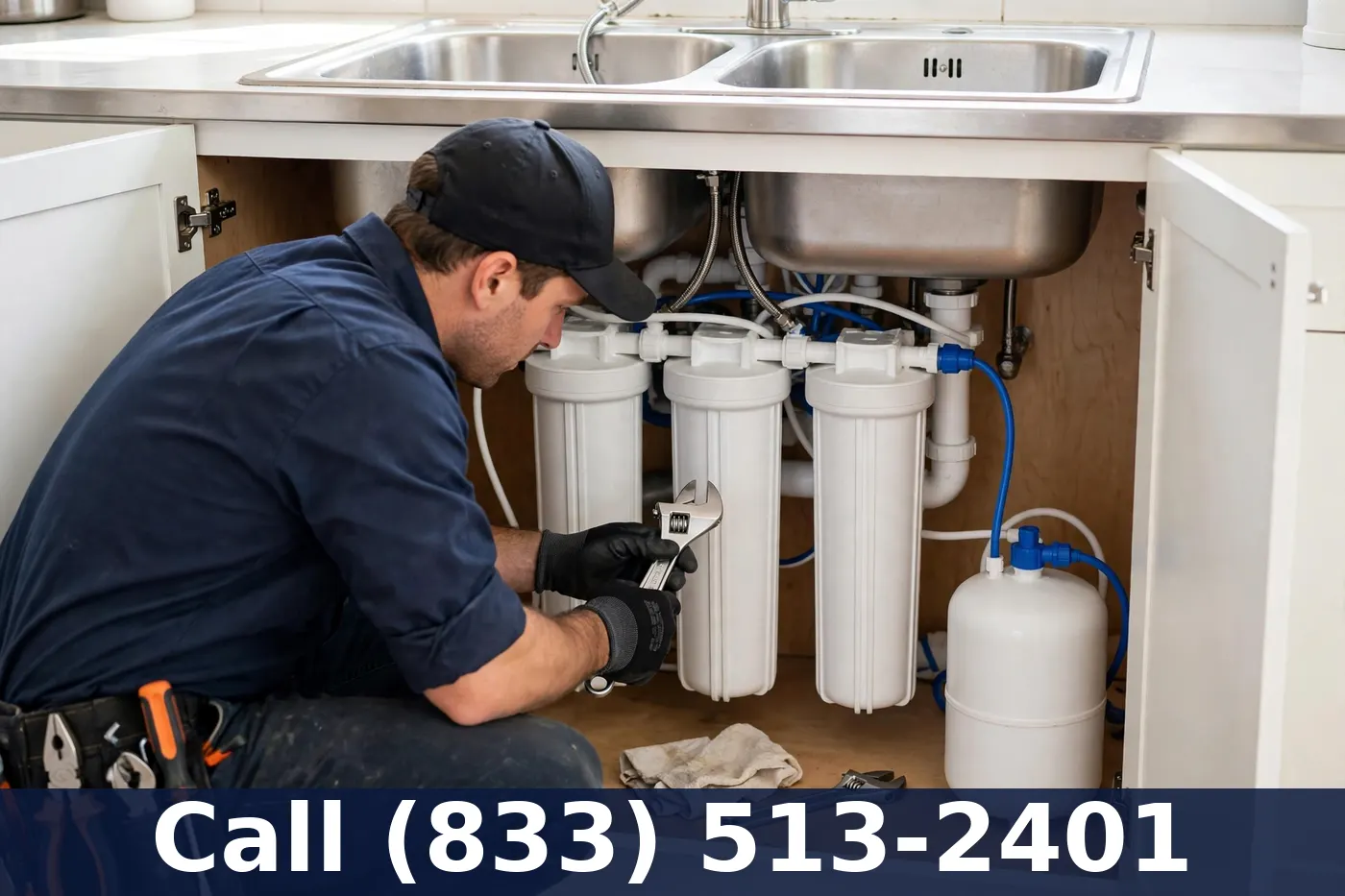
Starting price: Call for pricing
A reverse osmosis system pushes tap water through a semi-permeable membrane that blocks dissolved solids, lead, chlorine byproducts, and many other contaminants, delivering purified water to a dedicated faucet. Most residential systems mount under the kitchen sink with a small storage tank. Plumbing Services Pros installs complete multi-stage RO systems — filters, membrane, tank, faucet, and drain connection — sized for your household. This service is for homeowners who want better-tasting, cleaner drinking water straight from the tap.
What a reverse osmosis system does
Reverse osmosis forces tap water under pressure through a semi-permeable membrane. Water molecules pass through; dissolved contaminants — lead, arsenic, nitrates, fluoride, chlorine byproducts, PFAS compounds, and dissolved minerals — largely do not. What reaches your glass is water with far fewer total dissolved solids than what came out of the tap.
A complete residential system is not just the membrane. Water passes through stages: a sediment pre-filter catches sand and rust that would clog the membrane, carbon filters strip chlorine and chemicals that would damage it, the membrane does the heavy lifting, and a post-filter polishes taste before the water reaches the faucet. Each stage protects the next, which is why a properly staged system outperforms a single cartridge every time.
The reasons homeowners ask for RO
- Tap water with a chlorine, metallic, or mineral taste
- A water test that flagged lead, arsenic, or other contaminants
- White scale crusting on kettles, fixtures, and coffee makers
- A household going through cases of bottled water every week
- Concerns about PFAS or disinfection byproducts in the supply
- Wanting one tap in the kitchen with reliably clean water
How the installation goes
We start by looking under your sink: cabinet space, the cold water supply, the drain setup, and where a dedicated faucet can go. Most kitchens have an extra sink hole covered by a cap, or room to drill one cleanly in the sink deck or stone.
The install taps into the cold water line with a feed valve, mounts the filter and membrane assembly where it stays accessible for future filter changes, and sets the pressurized storage tank beside it. The membrane's reject line ties into the sink drain through an air gap fitting — that connection is what carries the concentrated contaminants away. The dedicated faucet goes in its hole with clean supply tubing run to the tank.
Then we sanitize the system, flush it according to the manufacturer's startup procedure, and check the filtered water with a TDS meter so you can see the before-and-after numbers yourself. You leave with the filter schedule for your specific system and our number if anything ever seems off.
RO versus a softener versus a simple filter
These solve different problems, and mixing them up wastes money. A water softener swaps calcium and magnesium for sodium — it fixes hard water spots and scale but does not purify drinking water. A carbon filter improves taste and odor but leaves dissolved solids alone. Reverse osmosis is the drinking-water answer: it reduces the broadest range of dissolved contaminants of any common home system.
Some homes genuinely need two of the three — very hard water can shorten a membrane's life, so a softener upstream of the RO is a common pairing. We will tell you if your water calls for that or if RO alone does the job.
What affects the cost
Stage count and membrane capacity set the baseline: a basic multi-stage unit costs less than a high-capacity system with remineralization and a designer faucet. The plumbing side depends on your under-sink space — a clean, open cabinet is quick work, while a crowded one with a disposal, instant-hot, and existing filtration takes more rerouting. If there is no spare sink hole and the counter needs drilling, that is part of the job too.
What the system does not need is guesswork. Tell us what bothers you about your water when you call (833) 513-2401 — taste, test results, scale, bottled-water habit — and we will spec the right system and quote it.
Who we install RO systems for in the area
Plumbing Services Pros installs reverse osmosis systems for homeowners across the Stockton area — families tired of the taste of their tap water, home buyers who tested the water during inspection, and anyone ready to stop hauling bottled water. It is also a popular add-on during kitchen remodels, when the sink area is already apart.
If you are curious what your water actually contains, call (833) 513-2401. We can talk through what RO removes, what it does not, and whether it is the right answer for your home.
Features
- Multi-stage RO system matched to your water and household size
- Sediment and carbon pre-filters to protect the membrane
- RO membrane assembly with proper pressure and flow
- Pressurized storage tank tucked under the kitchen sink
- Dedicated filtered-water faucet in a matching finish
- Drain connection with air gap for membrane reject water
- System sanitizing, startup flush, and TDS check before handoff
Benefits
- Drinking water that tastes noticeably cleaner
- Fewer dissolved solids, chlorine taste, and odors
- Less bottled water to buy, carry, and recycle
- A dedicated faucet delivering filtered water on demand
- Protection for the RO membrane through proper pre-filtration
- A tidy under-sink install that leaves cabinet space usable
- Know-how on filter changes so the system keeps performing
Frequently asked questions
How is reverse osmosis different from a regular water filter?
RO is a membrane process that removes dissolved solids — minerals, metals, and many chemical contaminants — that carbon filters leave behind. A carbon pitcher improves taste and odor but does not touch dissolved minerals. If your concern is total dissolved solids or specific contaminants flagged by a water test, RO is the stronger answer.
What does the installation involve under my sink?
Yes. We run a new cold water feed to the system, add a drain connection for the membrane's reject water, and mount a dedicated faucet — either in an existing sink hole or a new one drilled in the sink or counter. The storage tank and filter assembly sit under the sink.
Does a reverse osmosis system need a drain?
Yes, the membrane's concentrated reject water needs a drain connection, usually tied into the sink drain with an air gap fitting. That is standard for every RO install and part of what we set up.
What does a reverse osmosis system cost installed?
Cost depends on the number of filtration stages, the membrane capacity your household needs, the faucet style, and how much plumbing work the under-sink space requires. Systems range from basic multi-stage units to models with remineralization. Call (833) 513-2401 and tell us about your water concerns for a quote.
Will reverse osmosis water taste flat?
Some RO water tastes flat because the membrane removes nearly everything, including minerals that give water its familiar taste. Many systems add a final remineralization or polishing stage to bring some character back. If taste is your main concern, mention it and we will spec the system accordingly.
How often do the filters need changing?
The pre-filters get changed on their own schedule and the membrane less often — the exact timing depends on your water quality and how much water the household uses. We set you up with the schedule for your system and show you how to tell when a change is due.