
Sewer Line Replacement Near Me
Starting price: Call for pricing
Sewer line replacement swaps out a failed lateral for a brand-new pipe when repair no longer makes sense -- widespread collapse, crumbling material, or damage running the full length. Depending on the line's condition and what sits above it, the new pipe goes in by trenchless pipe bursting or by traditional open trench. Plumbing Services Pros starts every replacement with a camera inspection, so the method, the route, and the quote are based on what's actually underground.
When repair isn't enough anymore
There's a point where fixing sections of a sewer line stops making sense. If the camera shows collapse along most of the run, a pipe material that's crumbling from the inside out, or one bad section after another in an aging line, spot repairs become a treadmill -- each fix holds while the next weak point gives way. Replacement is the reset: the failed lateral comes out and a new, continuous pipe goes in, graded and bedded the way it should have been. It's the bigger job, but it's also the last time you deal with that line for a very long time.
Trenchless bursting vs. open trench
Two methods replace a line, and the choice depends on the pipe and the property.
Pipe bursting is the trenchless option. The crew digs an entry pit where the line leaves the house and an exit pit near the street connection, then pulls a bursting head through the old pipe. The head fractures the old pipe outward into the soil while a new high-density polyethylene pipe follows right behind it in one continuous run -- no joints for roots to work into. Lawns, driveways, and patios between the two pits stay put.
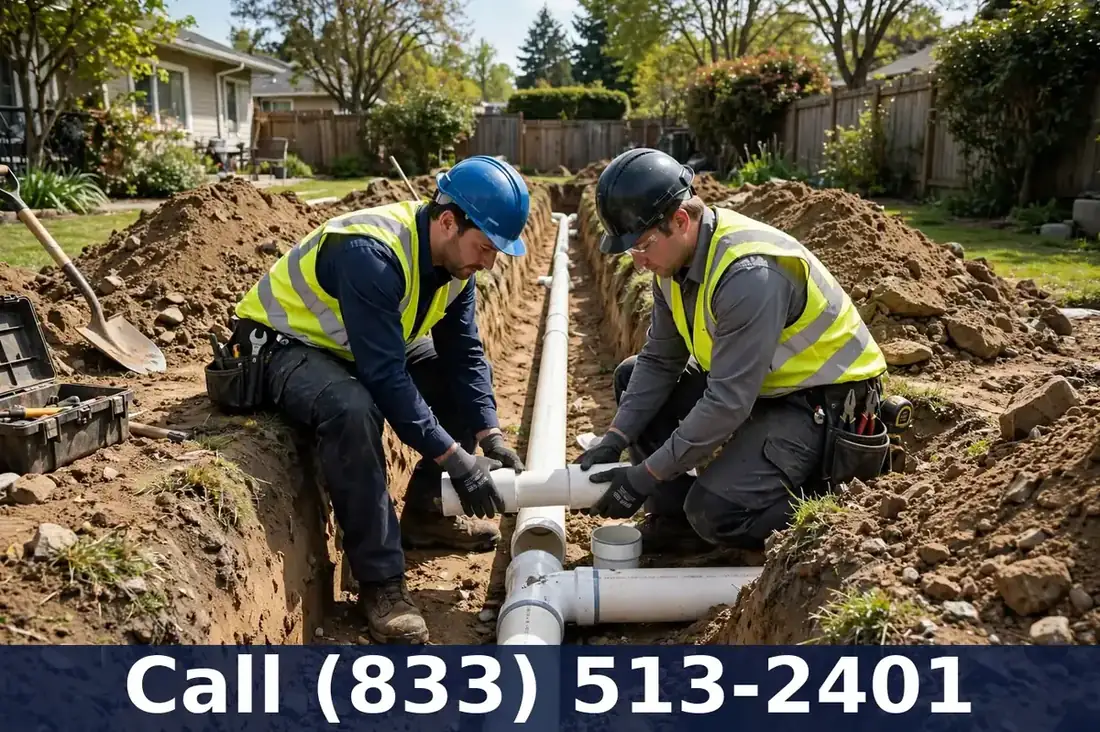
Open-trench replacement digs the full path. It's the fallback when trenchless doesn't fit: lines that have fully collapsed and filled with soil, lines with a sag that needs re-grading, very shallow runs, or lines running tight against gas or water services. It's more disruptive, but it lets the crew set the new pipe's exact slope and bedding by hand. Plumbing Services Pros recommends the method your line actually qualifies for, not the one that's easiest to sell.
How a replacement job runs
Every job starts with the camera: the line's route, depth, length, material, and connections get mapped and measured, and utilities are located before anyone digs. Then access is opened -- two pits for bursting, a full trench for open-cut. The old pipe is replaced, the new line is tied into the house plumbing and the downstream connection, and cleanouts are set at the access points. Before backfill, the line is tested and camera-verified: open, connected, flowing, and holding its grade. Then comes backfill in compacted lifts and surface restoration. Permits and inspection are handled where the local code requires them, so the finished work is documented.
Living through the work
A replacement is a construction project, but it doesn't have to take over your life. Most residential jobs run a few days from first dig to final backfill, with trenchless bursting often finishing the pipe work faster since there's no long trench to dig and refill. During key parts of the work you may be asked to limit water use -- the crew will tell you exactly when and for how long, and service is restored as soon as the new line is connected. You don't need to move out for the work. The noisy part is the excavation and, for bursting, the pull itself; the rest is connection and restoration work.
What affects the cost
Replacement pricing follows the real-world difficulty of your specific run. Depth and total length are the biggest drivers -- deeper and longer means more excavation, more pipe, more labor. What sits above the line matters too: open lawn is straightforward, while driveways, patios, retaining walls, and tight side yards complicate access and restoration. The method changes the math -- trenchless needs specialized equipment, open-cut needs more digging and surface repair -- and the number of branches or connections to re-tie adds work. Root removal, soil conditions, and permit and inspection steps round out the quote. Call (833) 513-2401 after a camera inspection for an exact quote on your run.
What you get at the end
A finished replacement leaves you with a new lateral from the house to the street connection: continuous pipe, correct slope, solid joints, and cleanouts at the access points for any future service. You get the post-install camera footage showing the line open and flowing, plus the permit and inspection documentation where required. Keep both. They're your proof of the work, and they're exactly what a future buyer -- or a future plumber -- will want to see.
Features
- Camera inspection and route mapping before any work is quoted
- Trenchless pipe bursting through the existing pipe's path
- Open-trench replacement where trenchless methods don't fit
- New continuous pipe with proper slope, bedding, and joints
- Cleanout installation at the access points as part of the job
- Utility locating and permit handling before excavation
- Backfill, compaction, and surface restoration when the work is done
Benefits
- The whole failed line is gone -- not patched, not lined over
- Trenchless option keeps the yard, driveway, and patio intact
- New pipe sized and graded for reliable flow
- Camera-verified result you can see before the trench is closed
- Documented work that stands up at inspection or resale
- No more repeat clearing calls on a line that kept failing
Frequently asked questions
How do I know my sewer line needs replacing instead of a repair?
The camera footage makes the call. Replacement is the answer when the line is collapsed along most of its length, the pipe material itself is disintegrating, or failures keep appearing faster than repairs can keep up. Plumbing Services Pros shows you the footage and explains why repair isn't the economical choice before quoting a replacement.
How long does a sewer line replacement take?
Most residential replacements run a few days from first dig to final backfill. Trenchless bursting often completes the pipe work faster because there's no full trench to dig and refill, while open-cut jobs add time for excavation and surface restoration. The camera survey beforehand gives a realistic timeline for your run.
Will I be without plumbing during the work?
Only during key parts of the job, and the crew tells you exactly when. During the bursting pull or the open-cut swap, you may be asked to limit water use; water use goes back to normal as soon as the tie-in is complete, and there's no need to leave the house during the project.
Can you replace the line without digging up my driveway?
Often, yes. Pipe bursting runs the new pipe through the old pipe's path using just an entry and exit pit, so driveways, patios, and landscaping between them stay intact. If the line has fully collapsed, needs re-grading, or runs against other utilities, open trench may be required -- the camera survey decides.
What kind of pipe goes in?
Trenchless bursting pulls a continuous high-density polyethylene pipe with fused joints, so there are no seams for roots to enter. Open-trench replacements use solid-wall PVC with proper solvent-welded joints, bedded and graded to spec. Either way, the new line is camera-verified before backfill.
What drives the price of a sewer line replacement?
Depth and length of the run, the replacement method the line qualifies for, what's above the line (lawn versus driveway or patio), the number of connections to re-tie, soil and root conditions, and permit and inspection steps. Call (833) 513-2401 with your camera findings for an exact quote.