
Tankless Water Heater Installation Near Me
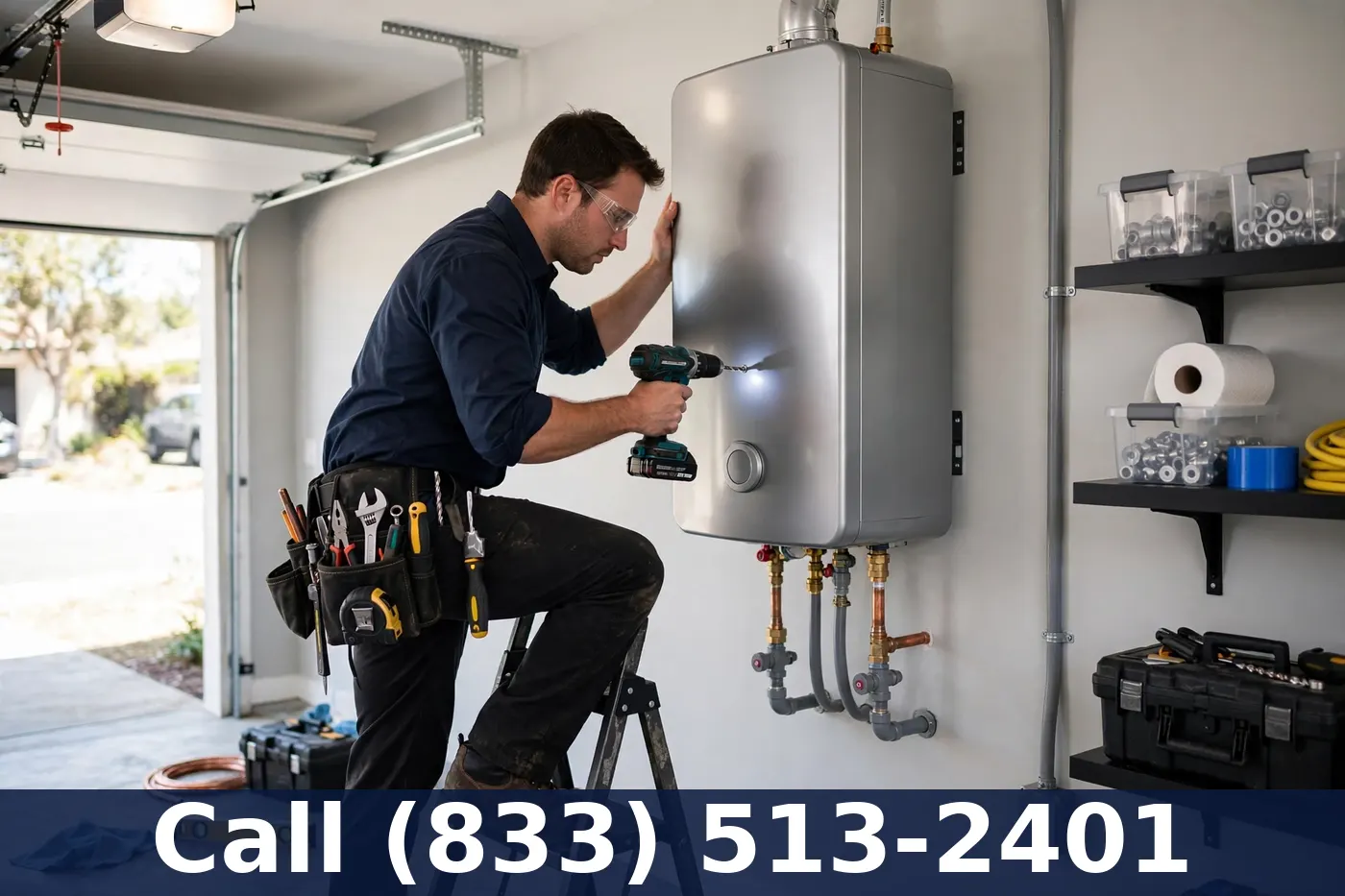
Starting price: Call for pricing
Instead of keeping a big tank of water hot all day, a tankless heater warms water only when a tap opens, in a compact unit on the wall. Plumbing Services Pros sizes the unit to your home's real hot-water demand, handles the gas, venting, and electrical work the new unit needs, and installs it to local code. You get hot water that doesn't run out and a utility area with room to spare.
What tankless installation actually involves
A tankless water heater is a box about the size of a suitcase that hangs on the wall. When you open a hot tap, cold water flows through a powerful burner or heating elements, and hot water reaches the fixture seconds later. There is no tank storing hot water, so there is nothing to run dry.
Installing one is a bigger job than swapping an old tank. Gas models burn far more fuel per minute than a storage heater, so the gas line often needs upsizing and the venting is completely different. Electric models draw serious amperage and usually need dedicated circuits, sometimes with a panel upgrade.
Homes that get the most from going tankless
Households that keep running out of hot water benefit first — big families, homes with deep soaking tubs, or anyone showering back to back. The wall-mounted unit also frees up real square footage, which matters in a garage, closet, or utility nook where every foot counts.
If your heater sits where a tank failure would be a disaster, going tankless removes that failure point entirely. Homes on hard water can still make the switch, but adding a scale-reduction device protects the heat exchanger from mineral buildup that chokes efficiency over time.
Signs the upgrade fits your situation:
- You run out of hot water during normal use
- The old tank hogs space you could use better
- Your tank is aging and you want something longer-lived
- A tank leak would damage finished space below or beside it
A walk through installation day
The day starts with the water shut off and the old heater drained and hauled out. The plumber checks the gas line, venting path, and electrical capacity before any new hardware goes on the wall.
Then the tankless unit gets mounted, the water lines are run, and the gas or electrical connections are made. Venting goes in next — sealed two-pipe systems for most gas models — along with a condensate drain on condensing units.
Finally everything is pressure-tested and the unit is fired up. Gas connections get leak-checked, flow rates are verified against your household demand, and the temperature is set. You get a walkthrough of the controls and what the display means before the job is done.
The extra work most tankless jobs include
Most homeowners are surprised by how much of the job happens around the unit itself. These supporting tasks are common:
- Upsizing the gas line from the meter so the burner gets enough fuel
- New vent runs through a wall or roof, since old tank flues rarely fit
- A condensate drain and neutralizer on high-efficiency condensing models
- Dedicated circuits or a panel upgrade for whole-house electric units
- Isolation valves on the water lines so the unit can be flushed yearly
- Permit paperwork and the inspection most areas require for fuel-fired appliances
What affects the cost of the job
The biggest cost drivers are the unit's heating capacity and how much supporting work the house needs. A short vent run through a nearby wall costs less in labor than a long route through the attic. A gas line that needs upsizing across the house adds material and time.
Electric installs hinge on panel capacity — plenty of room in the panel keeps things simple. Add-ons like a scale-reduction device or a recirculation pump raise the total but solve real problems. For an exact number based on your home, call (833) 513-2401 and describe your current setup.
Why call Plumbing Services Pros for your install
Plumbing Services Pros treats tankless installs as engineering, not just appliance swaps. The sizing math comes first, then the gas, vent, and electrical planning, then the clean installation — in that order.
Homeowners across the Stockton area and nearby communities get the same process whether the house is a newer build or decades old. To start, call (833) 513-2401, say you are thinking about tankless, and hear what the visit involves.
Features
- Hot-water demand sizing so the unit matches your household
- Gas line upgrades for high-BTU tankless burners
- Direct-vent or power-vent exhaust installed to code
- Condensate drain and neutralizer for condensing models
- Wall mounting plus hot and cold water line connections
- Isolation valves for easy flushing and service later
- Startup testing of gas, venting, water flow, and temperature
Benefits
- Hot water that keeps flowing through back-to-back showers
- Floor space back where the old tank used to sit
- No energy burned keeping stored water hot between uses
- A service life that stretches well beyond a typical tank
- Less chance of a ruptured tank flooding the house
- Steadier temperatures with fewer hot-cold swings
- A cleaner, more compact utility area
Frequently asked questions
How long does a tankless water heater installation take?
Most straightforward replacements are finished in a day. Jobs that need new venting routes, a gas line upgrade, or electrical work take longer, and your plumber will walk you through the plan before anything starts.
Will my gas line need to be bigger?
Often, yes. A tankless burner fires at a much higher rate than a storage tank's, so the half-inch line feeding your old heater is frequently too small. A plumber measures the run from the meter and sizes the pipe to carry the load safely.
Gas or electric tankless — which should I pick?
Gas units generally handle whole-house demand more easily, while electric units need no combustion venting at all. The right pick depends on your home's fuel supply, electrical capacity, and how much hot water you use at once.
What size tankless water heater do I need?
Size by flow rate, not gallons: add up the fixtures you run at the same time and match the unit's output at your area's winter temperature rise. Plumbing Services Pros runs that calculation before recommending a model.
How much does tankless water heater installation cost?
The unit's capacity, whether the gas line or electrical panel needs upgrading, how long the vent run is, permit fees, and any water treatment add-ons all play a part. Call (833) 513-2401 for a quote based on your home.
Does a tankless heater need maintenance?
Yes — a yearly flush keeps mineral scale off the heat exchanger, which protects efficiency and the unit's lifespan. The isolation valves installed at setup make each flush quick and clean.