
Toilet Repair Near Me
Starting price: Call for pricing
A running toilet, a weak flush, a leak at the base, a handle that needs jiggling — these are the small failures that make a bathroom miserable. Plumbing Services Pros repairs toilets by finding the actual failed part: the flapper, fill valve, flush valve, supply line, or seal. Most toilet problems are fixed in one visit with quality parts, and you get an honest answer when the smarter move is replacement instead.
The problems a plumber actually gets called for
Toilets fail in a handful of familiar ways, and each one has a sound. The constant hiss of a running toilet. The half-hearted swirl of a weak flush. The drip of a supply line. The ominous gurgle before a clog.
Behind every one of those sounds is a specific part that wore out. Toilets are simple machines — a tank, a bowl, and a few moving parts — which is exactly why most repairs are quick once the failed part is identified.
Reading the symptoms before touching a wrench
Diagnosis starts with listening to you and watching the toilet work. A toilet that runs every few minutes has a slow tank leak — the classic phantom flush. One that runs nonstop has a fill valve that will not shut off or a flapper that will not seal.
Water on the floor tells its own story. At the back near the supply line, it is a connection or valve. At the base, it is the seal under the toilet. Under the tank, it is the tank-to-bowl gasket or a hairline crack. Where the water shows up narrows the search before a single part is touched.
Inside the tank: where most repairs happen
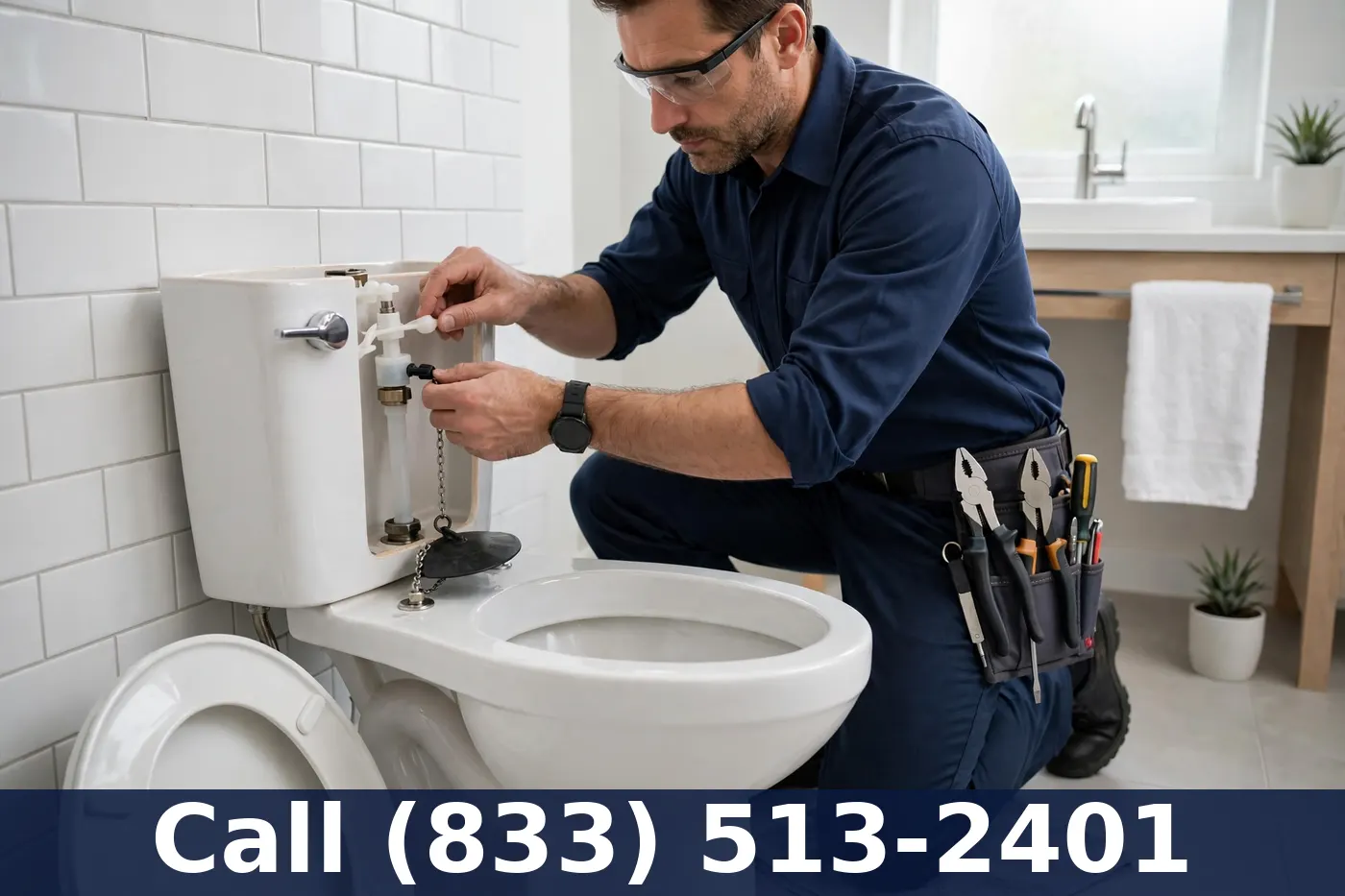
Pop the lid and you will see everything that usually fails. The flapper is the rubber seal at the bottom that lifts when you flush — it warps and hardens with age until water slips past it constantly. The fill valve is the tall assembly that refills the tank — sediment and wear keep it from shutting off.
The chain between handle and flapper needs just the right slack: too tight and the flapper never seals, too loose and the flush is weak. The water level needs to sit about an inch below the overflow tube. Most running-toilet repairs come down to one of these four things, and a stocked plumber fixes them in a single visit.
When the problem is below the bowl
Not every toilet problem lives in the tank. A toilet that rocks has a flange or seal problem underneath. Water at the base means the wax ring failed — and that repair means pulling the toilet, because there is no way to reseal it from above.
Chronic clogs often live in the trapway — the curved passage inside the porcelain — where buildup or a lodged object narrows the path. A closet auger clears what a plunger cannot reach. And sometimes the drain line beyond the toilet is the real culprit, which is why a plumber checks how the rest of the bathroom drains before blaming the fixture.
What affects the cost of a toilet repair
Tank-part repairs — flappers, fill valves, chains, handles — are the simplest jobs and the most common. The price climbs when the toilet has to come off the floor, as with base leaks and flange problems, because that work takes more time and a new seal.
Older toilets can complicate things when parts are discontinued, though most internals have universal replacements. If water has been leaking a while, repairing any floor damage adds to the total. Describe the symptoms to (833) 513-2401 and you will hear what the fix likely involves.
Repair or replace? An honest way to decide
Here is the rule of thumb Plumbing Services Pros uses: if the porcelain is sound and the problem is a worn part, repair it. Flappers, fill valves, and seals are inexpensive fixes that give a good toilet years more life.
Replacement earns its place when the tank or bowl is cracked, when repairs keep coming back, or when an old water-guzzler is driving up the bill every month. A plumber who profits from both will tell you which one you actually need — and that is exactly the call you get at (833) 513-2401.
Features
- Dye-testing to find silent tank leaks
- Replacing worn flappers and flush valves
- Replacing faulty fill valves and floats
- Adjusting water level and chain length
- Clearing clogged rim jets and trapways
- Fixing supply line and shutoff valve leaks
- Reseating toilets with failed base seals
Benefits
- The running stops and your water bill settles down
- A flush with real power behind it again
- Leaks fixed before they damage floors or ceilings below
- Clogs traced to their real cause, not just cleared
- Straight advice when repair no longer makes sense
- A toilet that works like it did when it was new
Frequently asked questions
Why does my toilet keep running?
Almost always the flapper or the fill valve. A worn flapper lets tank water leak into the bowl, so the fill valve keeps refilling — that is the running you hear. A plumber can confirm it with a dye test in minutes and replace whichever part failed.
Why is my toilet flushing so weakly?
Usually clogged rim jets, a low tank water level, or a worn flapper that closes too fast. Mineral buildup narrows the jets under the rim so less water swirls the bowl. Cleaning the jets and setting the water level right restores the flush on most toilets.
Water is leaking from the base of my toilet — how urgent is that?
Treat it as urgent. Water at the base means the seal between the toilet and the drain has failed, and every flush sends wastewater toward the subfloor. Shut the supply valve off if you can, stop using that toilet, and call (833) 513-2401.
My toilet clogs constantly. Is something wrong with it?
Occasional clogs happen, but weekly plunging means something is wrong — a partially blocked trapway, a venting issue, or an old low-flow design that never flushed well. A plumber can auger the trapway and tell you whether the toilet itself is the problem.
How much does toilet repair cost?
The failed part is the main driver — a flapper or fill valve is a smaller job than a cracked tank or a base leak that needs the toilet pulled. Access, part availability for older models, and whether water damage needs attention also factor in. Call (833) 513-2401 for a straight answer.
Can you repair any brand or style of toilet?
Yes — the internal parts work the same way across virtually all residential toilets. Whether it is a two-piece, one-piece, or wall-hung model, Plumbing Services Pros carries the common parts and can source the rest.